
Brazos County Parole and Probation
Parole is conditional release from a TDCJ prison sentence before the maximum sentence date. Mandatory supervision is another form of supervised state-prison release, governed by eligibility rules and Board review where required. Both are administered after release by the Texas Department of Criminal Justice Parole Division. Probation is a court sentence served under community rules. Brazos County Community Supervision and Corrections Department, or CSCD, administers adult probation ordered by a Brazos court.
The distinction controls the search. A TDCJ number, prison record, or Board vote points toward state parole channels. A county cause number and judgment imposing community supervision point toward the court and CSCD. A person may be out of jail on bond while no probation sentence exists. Another person may finish jail time yet remain on probation. “Released” and “discharged” are not synonyms: discharge means the legal supervision term has ended.
| Record | Authority | Best confirmation |
|---|---|---|
| Parole | TDCJ Parole Division after a Board decision | TDCJ record, Board status, regional parole office |
| Mandatory supervision | TDCJ and the Board where discretionary review applies | TDCJ detail and IVSS |
| Probation | Sentencing court and Brazos County CSCD | Judgment, docket, and CSCD |
| Full discharge | Agency or court that controlled the term | Official discharge record |
- Parole
- Supervised release from a state prison term.
- Probation
- A court-ordered sentence served in the community.
- Absconder
- A person the agency alleges stopped required contact or left an approved location.
- Discharge
- The formal end of custody or supervision, not merely release from a building.
Verify Brazos County Post-Release Supervision
Begin with the sentence rather than the live jail roster. The Brazos judicial portal can identify the cause, judgment, and whether the court ordered probation. The TDCJ Online Inmate Search is useful for a current prisoner and parole-review fields, but it expressly covers current TDCJ inmates and is not a complete archive of discharged people. Historical release or incarceration details can be requested from TDCJ at pia@tdcj.texas.gov.
- Match the full name to a Brazos court cause or a TDCJ or SID number. Avoid relying on a same-name result.
- Read the judgment. Community supervision language points to probation; a TDCJ sentence points to state release channels.
- For parole or mandatory supervision, check the TDCJ record, then use the Parole Division office directory to identify the responsible office.
- For probation, contact Brazos County CSCD and cite the court and cause number.
- Ask for public status and the controlling office. Do not seek or publish a confidential residence plan.
- Confirm the end of supervision through a discharge entry, order, or agency record.
A favorable Board vote is an intermediate event. TDCJ still reviews the release plan, residence requirements, discipline, special needs, programs, and special conditions. Release certificates, audits, and scheduling follow. Until the physical release occurs, describe the vote as approval subject to processing.
Brazos County Parole Review Records
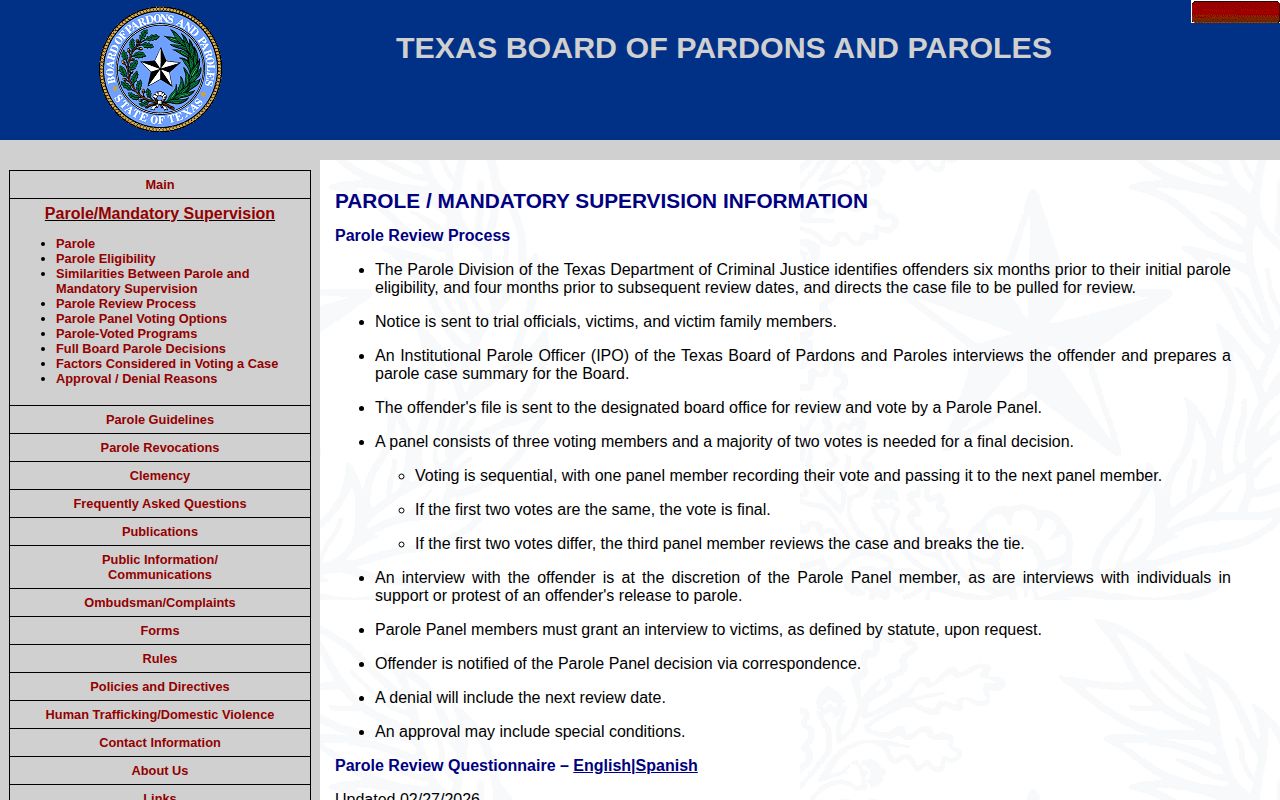
The Texas Board of Pardons and Paroles uses a three-member panel. An Institutional Parole Officer prepares the case summary, and two matching votes decide the result. TDCJ says review normally starts six months before initial eligibility and four months before a later review. A denial states the next review date. An approval can impose conditions or require a program before release.
Vote codes need careful reading. FI-1 means release when eligible, while FI-2 identifies a future month and year. Several “R” vote types require a named program before release. RMS concerns release to mandatory supervision. NR denies release and sets another review; SA directs service of the balance subject to controlling law. None is an out-date. Government Code sections 508.145 and 508.149 govern eligibility and mandatory-supervision exclusions, with the applicable rule depending on the offense and date.
Individual review status belongs in the TDCJ offender detail or the pre-vote status line at (844) 512-0461. After a favorable vote, Review and Release Processing handles status at (512) 406-5202. TDCJ reports that scheduling can take about 14 to 21 business days after Classification and Records receives a release certificate, and the date can still change.
The official Board review page explains the vote and review sequence.
Brazos County Supervision Offices
Brazos has a two-office split that prevents many false assumptions. The Bryan/College Station District Parole Office handles assigned state parole and mandatory-supervision cases. Brazos County CSCD handles adult probation ordered by local courts. “Supervision after jail” does not reveal which office has authority. The judgment and TDCJ history do.
State parole and mandatory supervision
Bryan/College Station District Parole Office
1700 George Bush Drive East, Suite 150
College Station, TX 77840
(979) 693-4977
Release processing
8610 Shoal Creek Boulevard, Austin, TX 78757
(512) 406-5202 status line
For probation, start with the Brazos judicial portal, identify the judgment and cause number, then contact CSCD. A court docket is also the better source for a modification, revocation motion, or order ending community supervision. State parole personnel cannot verify a county probation term, and CSCD cannot establish a TDCJ parole release.
Brazos County Supervision Alerts
Texas now uses two victim-information portals. TDCJ IVSS covers state custody, parole, and mandatory supervision. IVSS-Counties receives county jail and court events. These services can send notice by available phone, text, or email methods, but they are notification layers. The original court, jail, Board, or TDCJ record remains the source to verify an event.
The Texas DPS Sex Offender Registry is narrower. It may display a released person only when chapter 62 imposes a registration duty. Absence from that registry says nothing about release or supervision. TDCJ also links a specialized Sex Offender Absconder Information Search. It is not a broad parole lookup and should never be treated as one.
Brazos County Absconder and Violation Status
Conditions can address reporting, travel, residence approval, treatment, programs, fees, or other terms stated in the release certificate or probation order. A reported violation does not by itself prove revocation. The supervising agency investigates, and the governing process decides the result. A warrant or hold may lead to custody, but the related official record must identify the authority.
An absconder label means the agency alleges a person failed to remain in required contact or location. It is not a new conviction. Verify the label with the agency responsible for that supervision and use the correct identifiers. If the person returns to custody, distinguish a county booking, a TDCJ warrant process, and custody held for another agency. Each has a different record trail.
Property After Brazos County Release
The Sheriff’s published detention duties say staff inventory personal property at intake and verify identity and documentation at release. That does not establish one rule for every booking. Contact the Brazos County Detention Center about property tied to the specific booking, especially when property was released to another person before discharge or the individual transferred to TDCJ.
A record correction also follows its creator. Raise an error in a jail release event through the Sheriff’s records process. Direct a wrong judgment or disposition to the clerk and court. TDCJ fields belong with inmate-information or Public Information Act channels. These routes correct distinct records and should not be merged.
Ending Brazos County Supervision
Physical release is only the start of many supervision terms. Parole or mandatory supervision ends when TDCJ records a discharge under the sentence and applicable law. Probation ends under the court’s judgment and later orders. A jail-roster disappearance, an expired alert, or a closed web session proves none of those events.
Obtain the final record from the office that had authority. For probation, use the court file and CSCD. For state supervision, request the TDCJ incarceration and release history or other public record. The broader Brazos County released-inmate search explains how to reconcile the jail out-date, court result, transfer, and discharge without treating one screen as the whole record.