
Brazos County Projected and Actual Dates
A projected release date is a forecast based on the sentence, legal eligibility, credits, and information then held by the agency. A scheduled release date is a later operational field that may appear after formal release processing. The actual release date records when custody ended or transferred. These dates should never be collapsed into one.
TDCJ defines Projected Release Date as the date Classification and Records expects release if parole does not occur sooner. Maximum Sentence Date reflects the sentence endpoint under the agency’s calculation. Parole Eligibility Date marks when review can occur, not when release will occur. If release is formally scheduled, the offender detail may show a Scheduled Release date and location, but TDCJ warns that both can change even on that day.
A person awaiting trial at the Brazos County Detention Center has no sentence-based date to calculate. A bond order may authorize release, but another charge, warrant, detainer, or processing step can keep the person in custody. The docket explains court authority; the jail record supplies the physical out-date.
Find a Brazos County Release Date
First identify where the person is held and why. County jail time, a TDCJ commitment, federal imprisonment, and an agency transfer use separate record systems. The Brazos County released-inmate lookup covers the broader custody decision when the correct system is not yet clear.
- Check the Brazos judicial portal for the cause, bond events, judgment, sentence, commitment, and later orders.
- For a local sentence, contact the Detention Center’s Serve Time Coordinator at (979) 361-4802 and cite the booking and cause.
- For a TDCJ commitment or movement question, use the county TDCJ Coordinator at (979) 361-4803 and the statewide offender search.
- Search TDCJ by number when possible, open the matching detail, and read eligibility, projected, maximum, scheduled, and location fields separately.
- If the person is absent from the current-only TDCJ locator, email pia@tdcj.texas.gov for incarceration and release history.
- Confirm the actual release with the jail or TDCJ and follow any named receiving agency.
The county fork is unusually precise. Local jail-credit and sentence questions belong with serve-time staff. State-prison commitments and TDCJ movement belong with the TDCJ coordinator and state records. Sending both questions to one desk can produce a correct answer to the wrong custody period.
TDCJ Release Fields for Brazos County
The TDCJ Online Inmate Search covers people currently incarcerated in a TDCJ facility. It updates on working days and says its data is at least 24 hours old. Search with a TDCJ or SID number when available, then compare identity details before opening the record.
| Field | Meaning |
|---|---|
| Current facility | The TDCJ location in the current record |
| Parole Eligibility Date | A review threshold, not an out-date |
| Projected Release Date | Classification and Records forecast if parole does not occur sooner |
| Maximum Sentence Date | The calculated sentence endpoint |
| Scheduled Release | A changeable date and location after scheduling reaches that stage |
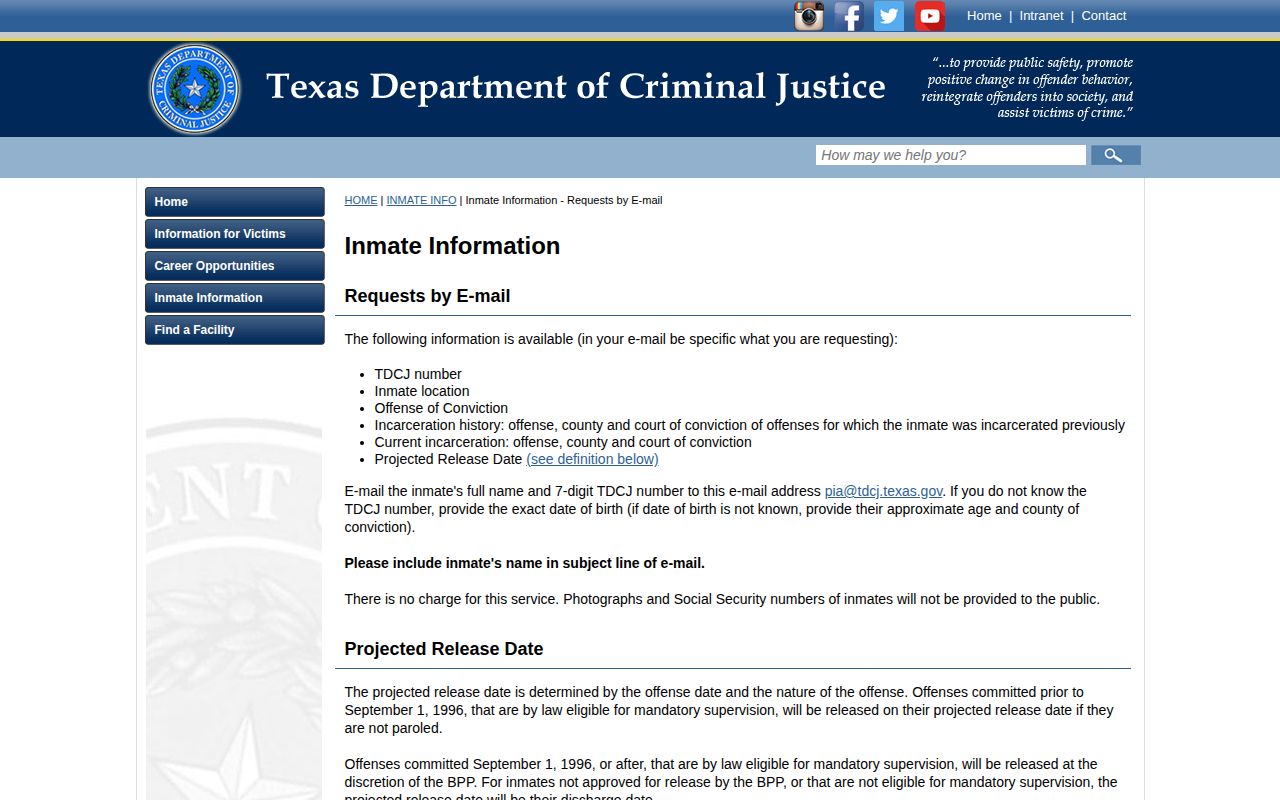
Disappearance from this locator does not prove discharge because it is not a released-person archive. Historical confirmation is available by email. Give the full name and seven-digit TDCJ number or, if the number is unknown, exact date of birth or approximate age and the conviction county. State which incarceration, conviction, and release details are sought. TDCJ says this email service has no charge.
TDCJ’s inmate-information page defines projected release and explains the historical email route.
Texas Time Credits and Release
Texas release calculations depend on the offense, offense date, sentence, custody type, and statutory eligibility. Government Code chapter 498 governs TDCJ good-conduct time. Good time can affect classification, parole eligibility, or mandatory-supervision calculations where the law permits. It does not simply reduce every sentence by one fixed percentage, and it is not a vested right to an earlier release.
Government Code section 508.145 contains parole-eligibility formulas that vary by offense and date. Section 508.149 excludes specified cases from mandatory supervision. For an eligible offense before September 1, 1996, flat time plus good time reaching the sentence can produce a scheduled mandatory-supervision date. For eligible offenses on or after that date, discretionary mandatory supervision may require Board approval. A denial can move the projection to maximum expiration.
Texas has no single “serve 85 percent” rule that accurately describes all TDCJ sentences. Some offenses require set portions of flat time before parole eligibility, while other restrictions apply through distinct statutes. The current law tied to the offense date controls. County jail credit also should not be computed by copying a TDCJ formula. The Serve Time Coordinator is the local source for a Brazos jail sentence.
Why Brazos County Release Dates Change
A forecast can move for legal, factual, or administrative reasons. The safest wording preserves the field name and retrieval date. “Projected for” does not mean “will be released on,” and a Board approval does not mean release processing is complete.
| Factor | Possible effect | Where to verify |
|---|---|---|
| Good-time change | Credit gain or loss changes an eligible calculation | TDCJ Classification and Records |
| Board action | Approval, denial, next review, or program condition alters the path | Board decision and release processing |
| Detainer or hold | Another agency may receive custody | Holding and receiving agencies |
| Court order | Sentence, credit, modification, or mandate changes authority | Cause docket and signed order |
| Program requirement | Completion may be required before release | Exact Board vote and TDCJ |
| Data lag | The public screen trails current agency action | Direct agency confirmation |
Specific detainer data can be restricted in TDCJ records under Government Code section 552.134. A public user may need to confirm the custody path with the receiving agency rather than expect a full online explanation. A transfer ends one facility’s custody but is not release to the community.
Brazos County Parole Scheduling
Parole review normally begins before the eligibility date. A three-member panel votes, and two matching votes decide. Favorable codes can require a future month, a treatment program, or another condition. TDCJ then checks the release plan, residence, discipline, special needs, programs, and legal criteria before issuing a release certificate.
Review and Release Processing reports that scheduling may take about 14 to 21 business days after Classification and Records receives the certificate. Dates remain subject to change. Call (512) 406-5202 for the processing stage. Do not treat that estimate as a promise for a particular person.
Confirm Brazos County Actual Release
Use notifications for a pending event, then confirm at the source. Brazos County VINE and IVSS checks explain the current county and TDCJ portals. IVSS is not the release ledger, and an “out of custody” event can follow a transfer.
For a local jail booking, request the recorded release date, time, type, authority, and destination through the Sheriff’s JustFOIA portal or call (979) 361-4800. For TDCJ, use the current detail, IVSS, release-processing line, or historical inmate-information request. Keep projected, scheduled, and actual dates labeled exactly as the agency reports them.
Brazos County Jail Date Evidence
The court and jail answer separate parts of a county release. A bond order, dismissal, sentence, or credit order establishes legal authority in the cause. The jail’s dates-of-incarceration product and release sheet show the period actually spent in custody and the recorded out-event. One can update before the other, so a court entry should not be converted into a physical release time.
The Sheriff lists dates of incarceration as a $5 product and a certified statement of time at $1. A focused JustFOIA request can seek the booking and release date and time, release code or authority, charge-level disposition, and destination agency when transferred. Ask for a policy defining an unclear code rather than guessing.
For a local time-served dispute, gather the judgment, sentence, jail-credit orders, and booking dates before calling the Serve Time Coordinator. If the court later modifies the sentence or credits, obtain the signed order from the District Clerk. This chain is more reliable than calculating a date from sentence length alone.
Brazos County Transfer Date Limits
A departure from the Detention Center may mark transport to TDCJ, another county, federal custody, or immigration custody. It is an out-date for the county booking, not necessarily release to the community. Follow the receiving system. Use TDCJ for state movement, BOP for federal custody, and ICE ODLS for immigration custody.
Government Code section 552.134 can restrict specific TDCJ inmate and detainer information. When a public record omits details, report only the confirmed transfer and contact the receiving agency. Silence in one portal cannot safely become a release conclusion.